

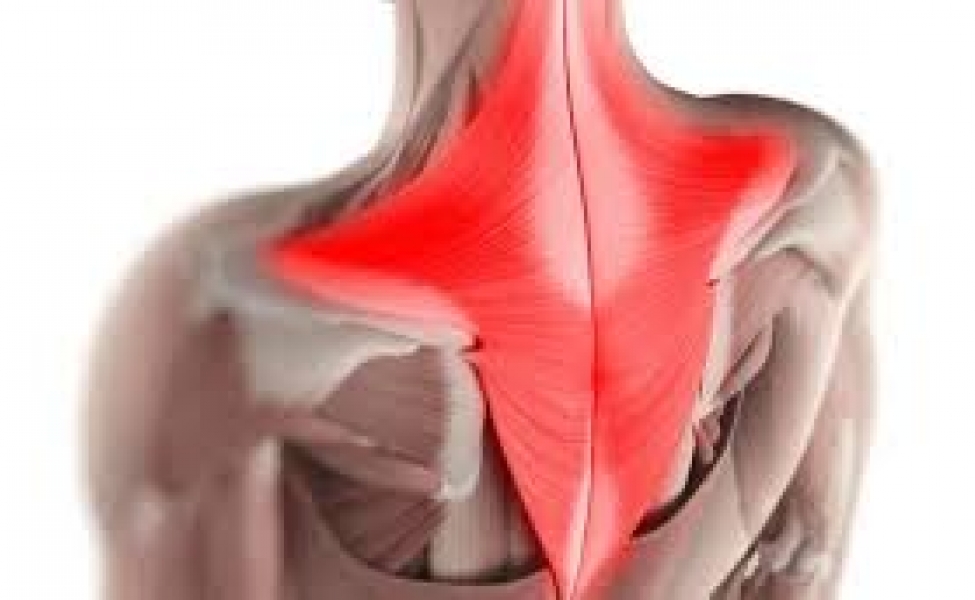
How tension in your shoulders reveals more than you might think
Trapezius syndrome – also known as myofascial tension of the trapezius muscle – is one of the most common complaints in modern practice. Long working days spent at a computer, stress, static postures and a lack of relaxation make the trapezius one of the most vulnerable areas of the body.
Although Western medicine often views it as a purely mechanical problem, Traditional Chinese Medicine (TCM) takes a much broader view. In TCM, muscle tension has a deeper significance: it reflects a disruption in the flow of Qi, emotional strain and an imbalance between the meridians.
In this blog, we explore how TCM interprets trapezius syndrome – and, above all, how we can treat it effectively.
The TCM perspective: why the trapezius muscle is so vulnerable
The trapezius is the point where several meridians converge.
- This meridian activity makes the muscle energetically sensitive.
Meridians that influence and pass through the trapezius muscle:
From the shoulder blade to the spine on both sides:
the 4 Yang meridians
Gallbladder – Triple Burner – Small Intestine – Bladder – Governor
The Gallbladder Meridian (GB)
The upper trapezius and the area around the shoulders are traversed by the.
When Liver Qi stagnates due to emotional stress or frustration, the tension literally ‘rises upwards’, with tender points at the level of GB20, GB21 and the top of the shoulder
Triple Heater (DV)
Runs horizontally from the back of the shoulder at 14 DV, across the supraspinatus muscle, to 15 DV
Small Intestine (DUD)
Runs from the back of the armpit, zigzagging across the shoulder blade
Bladder meridian (Bl.)
Runs vertically downwards in two branches, parallel to the vertebral column
Governor Meridian (GM)
Runs vertically upwards along the spine
Important:
3 ascending meridians :
Dv, DuD in GM
2 descending meridians:
GB and BL
This means that the Trapezius is a key hub in the energy transport network and, as such, is prone to numerous potential blockages, resulting in the familiar traffic jams
The Trapezius area is like the Four Arms Crossroads in Brussels
The result is that stress and emotions cause qi stagnation, which manifests itself particularly in this area
The distinct Yang area
-
Yang energy rises upwards along the neck and shoulders. When this Yang is not sufficiently grounded – often due to fatigue, anaemia or exhaustion – it leads to rising tension, headaches and stiffness.
Wind invasions
In TCM, the upper back and neck are regarded as the “meeting point of external pathogens”.
A sudden stiff neck after being exposed to a draught?
In TCM, we refer to this as: Wind-Cold blocking the meridians, which can cause tension and trigger points.
Symptoms associated with trapezius syndrome in TCM
- Stiff neck and limited rotation
- Occipital headache
- A pressing pain mainly along the Du and GB meridians
- Fatigue or a feeling of “tension in the shoulders and neck”
- A nagging pain that gets worse with stress
- Tingling in the arms or hands (in cases of severe stagnation)
- Pain between the shoulder blades
Many patients describe the sensation as if they are “carrying too much” – a metaphor that TCM recognises literally as Qi stagnation and overloading of the Yang areas.
Diagnosis according to TCM
The diagnosis is based on the four classic pillars:
- Palpation of the trapezius muscle and acupuncture points
Typical trigger points are found in:
- GB21 – Jianjing
- SI11 – Tianzong
- BL43 / BL44 – for interscapular pain
- Du14 / Du15 – Wind gates
- Ashi points
Pulse diagnosis
We often see:
- Tense wrist → Stagnation of Liver Qi
- Weak, empty pulse → Qi and Blood deficiency
- Floating & tight → Wind-Cold invasie
Tongue diagnosis
Common patterns:
- Red on the sides → Liver heat / stagnation
- Pale tongue → Qi and blood deficiency
- Thick white batter → Cold invasion
- Thick, greasy batter → Steam invasion
Treatment strategies in TCM
-
Acu-LED acupuncture
The most direct treatment for relaxing the trapezius muscle and promoting the flow of Qi.
According to traditional acupuncture:
- GB21 – Relaxes the shoulders, directs the Qi downwards
- GB20 – Dispels wind, relaxes the neck
- LI4 & LV3 (Four Gates) – Moving Qi throughout the body
- BL10 / Du16 – Opens the neck region
- SI11 / SI12 – Myofascial release and local blood flow
- SI3 : relieves qi stagnation in the SI meridian
According to Tung acupuncture:
Local:
de Red Light Therapy patch
Distal:
77-05-06-07: on the opposite side to the area of greatest pain
3SI en 3SJ : guiding points
Volgens JIN RUI THREE NEEDLES :
- GB21 — Jianjing
Main action: relaxes the upper trapezius, moves Qi, directs Yang downwards.
- The primary needle for immediate relaxation.
- Often the most tender trigger point in trapezius syndrome.
- SI11 — Tianzong
Main action: opens up the shoulder blade area, relaxes the scapular muscles, and treats myofascial tension.
- Loosens the middle section of the trapezius and rhomboid muscles.
- Reduces pain radiating towards the arm or shoulder blade.
- GB20 — Fengchi
Main action: relaxes the neck, disperses Wind, opens the Yang meridians that run through the trapezius muscle.
- Crucial for stiff necks, occipital headaches and tension in the GB line.
- Improves blood flow to the base of the skull and the upper trapezius muscle.
Photobiomodulation
Red and infrared light waves penetrate deeper into the myofascial tissue, reducing inflammation and improving microcirculation.The Red Light Therapy patch can be applied to the painful area for 15 minutes with the aim of:
- Relief from muscle and joint pain
- Improvement of microcirculation
- Anti-inflammatory effect
- Promoting cell repair and relaxation
Herbal medicine (Phytotherapy)
Classic formulas suitable for trapezius syndrome:
General :
- Jing Jian Bei Tong Fang
In cases of Liver-Qi stagnation
- Chai Hu Shu Gan San
When you have wind-chill in your shoulders
- Ge Gen Tang
For chronic pain caused by blood stasis
- Shen Tong Zhu Yu Tang
Self-care according to TCM
Therapists can give patients some simple advice:
- Heat on the shoulders (Yin balm, moxa stick, heat patch)
- Daily stretch for the upper trapezius and levator scapulae
- Breathing exercises to harmonise Liver Qi
- Regular breaks when working at a computer
-
Wind protection: no draughts on the neck and shoulders
Conclusion
Trapezius syndrome is much more than just a localised muscle problem.
In TCM, this region tells us something about:
- Qi circulation
- Emotional strain
- Liver meridian balance
- External factors such as wind and cold
A holistic approach – Acu-LED acupuncture, herbal medicine and photobiomodulation – often provides rapid, long-lasting relief and helps clients move freely again.